Posts

Showing posts with the label digital archiving

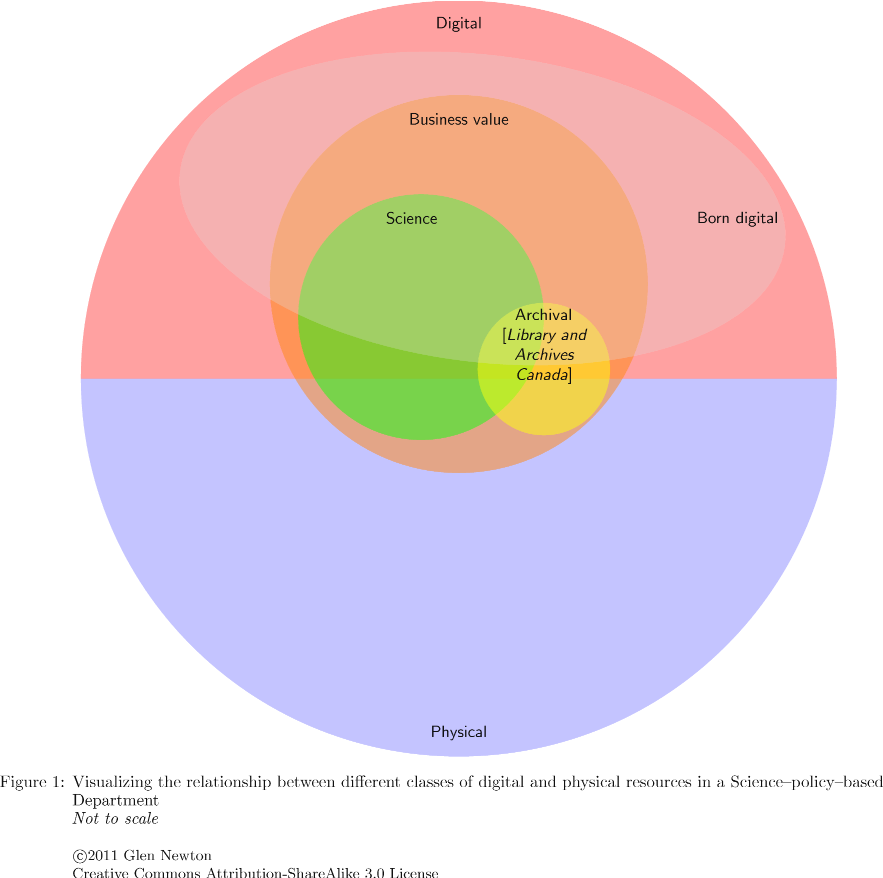
Visualizing the relationship between different classes of digital and physical resources in a Science-policy-based Department
Image
Some of my work includes consulting with the Canadian Forestry Service (CFS) at Natural Resources Canada (NRCan) in the area of scientific data management, digital repositories / archiving and project management. Some of the work revolves around the interpretation and application of various records keeping and archival policies, such as those from Treasury Board Secretariate's Directive on Record Keeping and Library and Archives Canada. Some of these policies are difficult to interpret or are still in flux, and I have had some difficulties in interpreting the terms, definitions, etc. of these policies. I find that visualizing things (or the act of creating a visualization) can often help in understanding. So I've put together the following Venn diagrams to help (me mostly). I've tried to generalize to any Science-base-policy department in the government of Canada. Caveat : This is my own view of what I have seen and interpreted, and may be incorrect. It is not deri...

Research Data and Metadata at Risk: Degradation over Time

Image
Research data and metadata - usually derived from an experiment or series of experiments - is in the hot focus of the researcher during the experiment and the subsequent interpretation, paper writing and publishing. But once the researcher has moved on to their next effort, this data is very much at risk. Often (read ' the-rule-rather-than-the-exception '), the data is not properly managed and archived, and resides as a single copy on the researcher's desktop or maybe research server. In addition, the metadata is minimal or non-existent, and if it does exist is only interpretable by the researcher and their colleagues or students. Over time, the chance that this data will be lost or useful knowledge about it forgotten by the researcher increases, and the information content of the data and metadata rapidly decreases. Some events can seriously accelerate this decrease: data loss (media failure, computer replacement, other serious accidents or failures, etc); change of care...