Posts

Showing posts with the label digital repositories

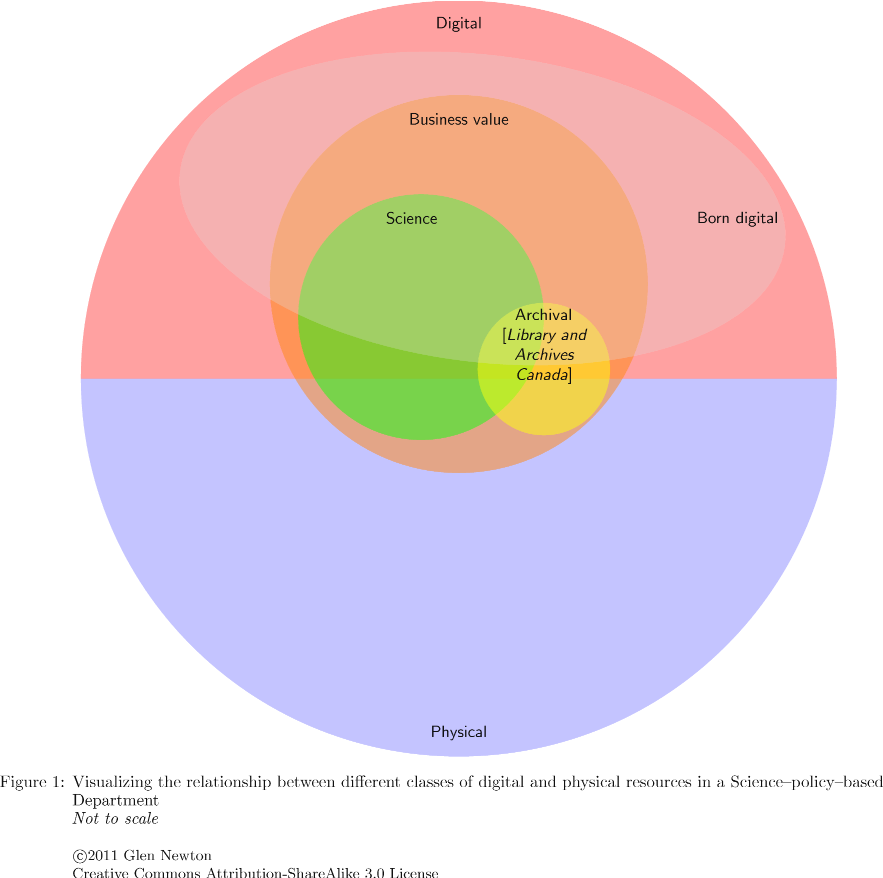
Visualizing the relationship between different classes of digital and physical resources in a Science-policy-based Department
Image
Some of my work includes consulting with the Canadian Forestry Service (CFS) at Natural Resources Canada (NRCan) in the area of scientific data management, digital repositories / archiving and project management. Some of the work revolves around the interpretation and application of various records keeping and archival policies, such as those from Treasury Board Secretariate's Directive on Record Keeping and Library and Archives Canada. Some of these policies are difficult to interpret or are still in flux, and I have had some difficulties in interpreting the terms, definitions, etc. of these policies. I find that visualizing things (or the act of creating a visualization) can often help in understanding. So I've put together the following Venn diagrams to help (me mostly). I've tried to generalize to any Science-base-policy department in the government of Canada. Caveat : This is my own view of what I have seen and interpreted, and may be incorrect. It is not deri...

Opening government funded research to improve research, teaching and learning in higher education

The report Harnessing Openness to Improve Research, Teaching and Learning in Higher Education (A Report by the Digital Connections Council of the Committee for Economic Development Committee, 2009 ISBN #0-87186-184-7) has some very relevant sections dealing with Open Access and Open Data in the context of higher education and the research process: Chapter 5. Openness in Higher Education: Changes in Research a. Resistance to Greater Openness b. Openness and Open-Access Journals c. Digital Repositories d. Educating Faculty Members on Their Intellectual Property Rights e. Openness and Commercial Support of Research f. Access to Government-Funded Research Results g. Openness and University Libraries h. Openness and Academic Presses i. Openness and Technology Transfer Of particular interest to those who - perhaps at a more general level - are working on getting better access to government funded research , are the following recommendations on this particular issue: f. Access to Governme...

Draft DCC Curation Lifecycle Model available for comment

The Digital Curation Centre 's (DCC) draft Curation Lifecycle Model is now available for comment. (Slightly) more information can be found in the paper Draft DCC Curation Lifecycle Model . Sarah Higgins. International Journal of Digital Curation , Issue 2, Volume 2, 2007.

CSIRO research program takes data leadership

CSIRO has announced a new program, Terabyte Science , (press release: From molecules to the Milky Way: dealing with the data deluge ) that is oriented around dealing with the issues of the large volumes of data generated by much of modern science. While this includes the difficult problem of the management of large volumes of data, this program will also focus on new ways to analyse and exploit this data. Kudos to CSIRO for recognizing this issue and realizing an important program for data science, both to their own country and the rest of us. Hopefully other such initiatives will take hold in other countries. And perhaps we will be seeing some of their work published in CODATA 's Data Science Journal . (Disclosure: I am an observer on the Canadian National Committee for CODATA ).

IJDL Special Issue: Connecting digital libraries to eScience

The International Journal on Digital Libraries has a special issue entitled " Connecting digital libraries to eScience". I haven't had a chance to read any of the articles, but they look very interesting, and include some discussion on various scientific data issues, collaboration, repositories, research infrastructure, etc: Connecting digital libraries to eScience: the future of scientific scholarship . Michael Wright, Tamara Sumner, Reagan Moore, Traugott Koch Not by metadata alone: the use of diverse forms of knowledge to locate data for reuse . Ann Zimmerman Little science confronts the data deluge: habitat ecology, embedded sensor networks, and digital libraries . Christine L. Borgman, Jillian C. Wallis, Noel Enyedy Collaborative eScience libraries . Linn Marks Collins, Mark L. B. Martinez, Ketan K. Mane, James E. Powell, Chad M. Kieffer, Tiago Simas, Susan K. Heckethorn, Kathryn R. Varjabedian, Miriam E. Blake, Richard E. Luce Pathways: augmenting interoperabilit...

Sustainable Digital Data Preservation and Access Network Partners (DATANET) CFP

The US National Science Foundation Office of Cyberinfrastructure has a call for proposals . From the call: The new types of organizations envisioned in this solicitation will integrate library and archival sciences, cyberinfrastructure, computer and information sciences, and domain science expertise to: provide reliable digital preservation, access, integration, and analysis capabilities for science and/or engineering data over a decades-long timeline; continuously anticipate and adapt to changes in technologies and in user needs and expectations; engage at the frontiers of computer and information science and cyberinfrastructure with research and development to drive the leading edge forward; and serve as component elements of an interoperable data preservation and access network. ...these exemplar organizations can serve as the basis for rational investment in digital preservation and access by diverse sectors of society at the local, regional, national, and international levels, ...

Data Archiving of Publicly Funded Research in Canada

Carol Perry presented this revealing study at last year's Access & Privacy Workshop 2006 held in Toronto. Its objectives were: "To assess the attitudes of academic researchers regarding the archiving of data resulting from publicly funded research To assess impediments to the creation of a national data archive program in Canada" She randomly polled 173 SSHRC grant recipients for 2004-2005 (with 75 respondents). Her results: "41% indicated they had current plans to archive their research data Of these, only 18.7% identified an established data archive as a deposit site for their data. 72% were not aware of SSHRC’s mandatory data archiving policy for all grant recipients 90% were not aware that Canada is a recent signatory to the OECD declaration on access to publicly funded data ." and •" In 2001: 60% favoured a national data archive 39% analyzed data created by others •In 2006: 69% favoured a national data archive 48% analyzed data created by others...