Posts

Showing posts with the label information retrieval

NSF Workshop report: Information Seeking Support Systems Workshop

The final report for the NSF Information Seeking Support Systems Workshop has been released . "The general goal of the workshop will be to coalesce a research agenda that stimulates progress toward better systems that support information seeking." From the executive summary: Our nation and our world depend on citizens who are able to seek, assess, understand, and use diverse kinds of information. Much of the information we need is complex with different components held in disparate electronic sources and many of our efforts to gather, assess, and use this information are done in collaboration with others. Additionally, much of the information we need is not discretely anticipated, but rather emerges as seeking and reflection continues over time. Information seeking in the digital age is a kind of problem solving activity that demands agile and symbiotic coordination of human and cyber resources; in short, a fundamental kind of computationally-augmented thinking. Computation ...
Microsoft Research Faculty Summit 2008: Publishing and Research Tools for Academics

The Microsoft Research Faculty Summit 2008 included Publishing and Research Tools for Academics that allows for archival annotation and structuring of Microsoft software produced documents, as well as supporting PubMed Central format . Additional sessions of interest: The Cyberspace Connection – Impact on Individuals, Society, and Research New Developments in Scholarly Communication Reflections on Directions in Artificial Intelligence What Will Be the Impact of Cloud Services on Science? Spotlights on Interdisciplinary Artificial Intelligence Research AI, Sensing, and Optimized Information Gathering: Trends and Directions Ontological Myths: Reducing the Confusion Social Networking and Semantics Toward Situated Interaction Statistical Machine Translation Research at Microsoft Research Interactive Machine Learning: Challenges, Methods, and Applications Information Extraction from Documents and Queries Contexts in Computer Science Education The Future of Research Clouds REAssess: Resou...

FREE THE ARTICLES! (Full-text for researchers & scientists and their machines)

At a recent plenary I gave [ earlier post ] at the Colorado Association of Research Libraries Next Gen Library Interfaces conference, I went a little off-script and was educating (/haranguing) the mostly librarian audience about the present-and-near-future importance of the accessibility of full-text research articles to their researchers and scientists. By accessibility of full-text I didn't mean the ability of a human to access the PDF or HTML of an article via a web browser: I was referring to the machine- accessibility of the text contained in the article (and the metadata and the citation information). I was concerned because of the increasing number of discipline-specific tools that use full-text (& metadata & citations) to allow users (via text mining, semantic analysis, etc.) to navigate, analyze and discover new ideas and relationships, from the research literature. The general label for this kind of research is ' literature-based discovery ', where new ...

"Places & Spaces: Mapping Science" exhibit @ NRC-CISTI

Image
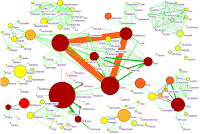
It is very exciting that the Places and Spaces: Mapping Science exhibit from Indiana University will be on display at NRC-CISTI from April 3 - June 27 2008. This is the first time this collection of amazing maps of science is on display outside the U.S. The diverse and creative collection includes traditional cartographic maps, concept maps and domain maps. These are all physical paper (+other media) maps, and also includes some hands-on maps made specifically for children to interact with. Congrats to all involved at NRC-CISTI and in particular my CISTI Research colleague Jeff Demaine who was the originator and champion of this initiative. References: Boyack, K.W., Klavans, R., Börner, K. (2005). Mapping the Backbone of Science . Scientometrics, 64 (3), 351-374. Update: 2008 April 15: Indiana University SLIS Events News: Mapping Science Exhibit at the National Research Council - Ottawa, Canada

Drill Clouds for Search Refinement

Image
I'd like to introduce something I call drill clouds , an extension to tag clouds for search refinement in information retrieval. I will be using an experimental Lucene -based search platform that I have developed, called Ungava (more in this later), which includes my implementation of drill clouds. Note that much of this posting is derived from a posting of mine on drill clouds on the CISTI Lab wiki . Drill clouds are what I call an extension to tag clouds to make them a useful tool for search refinement. That is, to use a tag cloud to refine an existing query by adding new elements to the query through interactions with the cloud. As this results in a kind of drill-down search behaviour, these new clouds have been named drill clouds . Some differences between traditional tag clouds and drill clouds: Tags in drill clouds can be any useful metadata and are not necessarily user applied or exclusively keyword-like (but can include controlled and uncontrolled vocabularies,...