Posts

Postscript coding resources

Image
Postscript is one of my favourite programming languages. Resources for postscript programming are not too common, and are always popping up and then disappearing, as things tend to do on the Web. Here is a snapshot of links that work: I will do my best to keep them up-to-date.

VPN Down? Fill your time (and brain) with free cloud training Part 2 of 2: Azure

  Part 2: Azure Free Azure educational material. Ordered (oddly enough) by time length. Non-exhaustive, personally selected for my team and peer teams , but I hope useful for you too.  :-) [Link to Part 1: AWS ] And full disclosure: I have no affiliation with either of these companies. 25 min: Core Cloud Services - Azure data storage options 25 min: Get started with Azure DevOps 28 min: Core Cloud Services - Azure networking options 30 min: Choose a data storage approach in Azure 34 min: Analyze your Azure infrastructure by using Azure Monitor logs 34 min: Control Azure services with the CLI 35 min: Align requirements with cloud types and service models in Azure 36 min: Add and size disks in Azure virtual machines 36 min: Core Cloud Services - Introduction to Azure 36 min: Create serverless logic with Azure Functions 37 min: Design an IP addressing schema for your Azure deployment 37 min: Monitor and troubleshoot your end-to-end Azure network infrastructure...

VPN Down? Fill your time (and brain) with free cloud training Part 1 of 2: Amazon Web Services

 In this difficult time, many of us are at home, teleworking, (and worrying about the world around us), waiting for someone else to get off the #*%#!$@# VPN so we can get on it, quickly read emails and copy files to work offline. But there is a limit in what you can do not connected to the Borg collective. In order to fill the remaining hours of the day, I've collected free AWS and Azure training material that you can use to make productive use of the time when you are not able to have a full pipeline of tasks on your plate. And perhaps to distract a little from the events of the day.  Part 1 AWS: About 75 hours of training material, ordered (oddly enough) by time length. Non-exhaustive, personally selected for my team and peer teams , but I hope useful for you too.  :-) [ Part 2 Azure : About 50 hours of training material. Sorry, less than AWS: I got tired of collecting it all!] And full disclosure: I have no affiliation with either of these companies. And plea...

Learning TikZ: Re-creating article diagrams with LaTeX / TikZ: #1

Image
I am trying to improve my LaTeX/TikZ skills, so I am re-creating on request scientific article diagrams. The first is here that I've made for a friend of mine: Original diagram (Note this diagram is copyright(c) Academy of Management; used here in a Fair Use fashion): TikZ diagram: The LaTeX code and instructions can be found at github . Licensed under a Creative Commons Attribution-NonCommercial-ShareAlike 4.0 International License If you have a diagram you'd like re-created, just add a comment to this blog post and we can talk. Expect a turn-around time of >1 week. I reserve the write to decline diagrams.  :-) ------------------------------------------ The paper the original diagram (Figure 1, p532) is from: An Organizational Learning Framework: From Intuition to Institution Mary M. Crossan, Henry W. Lane and Roderick E. White The Academy of Management Review Vol. 24, No. 3 (Jul., 1999) , pp. 522-537 Published by: Academy of Management   http:/...

chidley: XML to JSON converter, written in Go

I have just this morning released chidley , a code generator that reads XML and generates a Go program that can convert the given XML into JSON. Please see the github site for more details. I will be doing a series of chidley examples in this blog over the coming weeks.

rpmout: Go (golang) tools for listing installed RPMs in HTML,. LaTeX, json

rpmout is a utility for creating user facing rpm information written in Go. It extracts the rpm tag info (using the rpm command) and produces an HTML list fragment (default), JSON, simple text, and LaTeX. It can be restricted to the rpms that are implicated in a particular set of directories. My use is to produce a list of bioinformatics applications installed as RPMS on a Rocks cluster http://en.wikipedia.org/wiki/Rocks_Cluster_Distribution For example: users want to know what is installed in the bioinformatics install dir /opt/bioinformatics, and 'rpmout' generates (by default) an HTML fragment made up of a list of rpms and their useful attributes. This fragment is meant to be embedded into a static HTML page that wraps it with the appropriate local style, titles it, etc. Here is an example HTML output file: https://github.com/AAFC-MBB/rpmout/blob/master/sample.html.gz?raw=true (~1.4MB compressed) rpmout is my first real Go program, and I learned a lot about ...

Visualizing Canadian Energy Flows with d3.js Sankey diagrams

I have been working with processing.js but wanted to learn a little about d3js for visualizations, so took a look at Mike Bostock 's d3.js plugin for making Sankey diagrams . So I pulled down two documents that had energy flow diagrams for Canada: 2006. Powerful Connections: Priorities and Directions in Energy Science and Technology in Canada. The Report of the National Advisor Panel on Sustainable Energy Science and Technology , Natural Resources Canada, p76. 2008. Report on Energy Supply and Demand in Canada Catalogue no. 57-003-X, Statistics Canada, p121. I extracted the data from these diagrams and built these interactive Sankey energy flows: 2003 Canadian Energy Flows 2007 Canadian Energy Flows Note that these two documents are looking at slightly different views of energy flows (and 2007 does not include Uranium ), so can't be compared directly. If you have any (preferably Canadian) datasets that could be presented in this fashion, let...

My Google Scholar Citations page

I just took advantage of the opening-up of Google Scholar Citations and got my own page up . It is pretty cool to see your citations, etc. all pulled together.

IEEE Software on Software Business Models

The July/August IEEE Software [paywall warning] is a special issue on software as business, which includes one article that is Open Source oriented, and one that is "code sharing" oriented. Here are the articles: Guest Editors' Introduction: Software as a Business Software Industry Business Models Matching Open Source Software Licenses with Corresponding Business Models Sharing Source Code with Clients: A Hybrid Business and Development Model Developing Cloud Business Models: A Case Study on Cloud Gaming

Canada not involved in Aid transparency

The Aid Revolution begins with XML / The Aid Revolution Begins Here Publish What You Fund: The Global Campaign for Aid Transparency International Aid Transparency Initiative (IATI) Very oddly, Canada ( correction: Canadian government : see below) is NOT involved in this initiative , but the following countries and organizations are:    World Bank    Asian Development Bank    The European Commission (EC)    United Nations Development Programme (UNDP)    Global Alliance for Vaccines and Immunisation (GAVI)    Hewlett Foundation    Australia - AusAID    Denmark - Ministry of Foreign Affairs    Finland - Ministry for Foreign Affairs    Germany - Federal Ministry for Economic Cooperation and Development (BMZ)   Ireland - Irish Aid   Netherlands – Dutch Ministry of Foreign Affairs – Development Cooperation   New Zealand – NZAID ...

Comparative E-Government: Canada

Comparative E-Government Integrated Series in Information Systems Volume 25, 2010, DOI: 10.1007/978-1-4419-6536-3 Chapters involving Canada: Digital Government in North America: A Comparative Analysis of Policy and Program Priorities in Canada, Mexico, and the United States E-government Maturity over 10 Years: A Comparative Analysis of E-government Maturity in Select Countries Around the World  E-government and Federalism in Italy and Canada—A Comparative Assessment Adoption of Web 2.0 by Canadian and US Governments

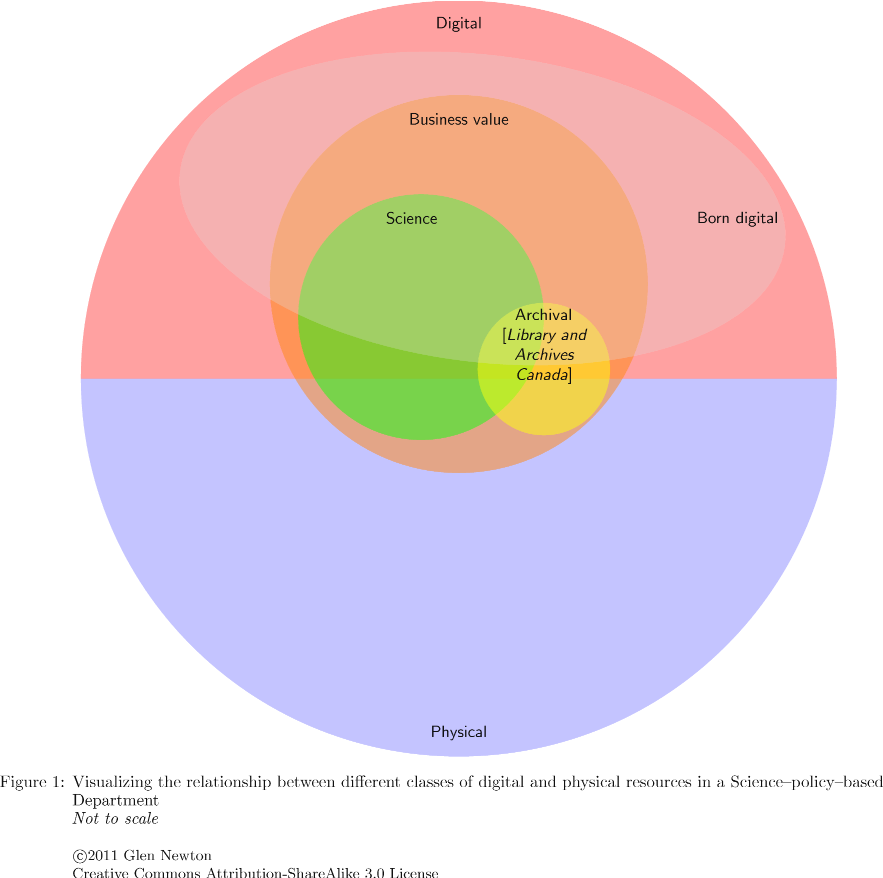
Visualizing the relationship between different classes of digital and physical resources in a Science-policy-based Department

Image
Some of my work includes consulting with the Canadian Forestry Service (CFS) at Natural Resources Canada (NRCan) in the area of scientific data management, digital repositories / archiving and project management. Some of the work revolves around the interpretation and application of various records keeping and archival policies, such as those from Treasury Board Secretariate's Directive on Record Keeping and Library and Archives Canada. Some of these policies are difficult to interpret or are still in flux, and I have had some difficulties in interpreting the terms, definitions, etc. of these policies. I find that visualizing things (or the act of creating a visualization) can often help in understanding. So I've put together the following Venn diagrams to help (me mostly). I've tried to generalize to any Science-base-policy department in the government of Canada. Caveat : This is my own view of what I have seen and interpreted, and may be incorrect. It is not deri...

"We Need a Research Data Census" - Francine Berman

F rancine Berman's call for a research data census in the U.S. recognizes the reality that the valuable research assets produced by public (and private) research funding is uncounted, mostly unmanaged, and destined to be, or in the process of being, degraded, damaged and lost. Lost to future research, re-use, re-purposing. While a census is useful when your knowledge about a topic is effectively zero , as in this case, I don't think that it is a good ongoing solution to this particular problem. Distributed and open research data repositories, open standards like OAI-PMH , rich metadata (and the tools to create/manage them) and the will of funding agencies and research organizations can all come together to make a real-time census possible. But an initial census is clearly needed, in order properly discover the complete nature of the research data problem, in order to plan the processes, infrastructure and organizations to properly deal it. Berman, F. 2010. We Need a Research D...

Research Data and Metadata at Risk: Degradation over Time

Image
Research data and metadata - usually derived from an experiment or series of experiments - is in the hot focus of the researcher during the experiment and the subsequent interpretation, paper writing and publishing. But once the researcher has moved on to their next effort, this data is very much at risk. Often (read ' the-rule-rather-than-the-exception '), the data is not properly managed and archived, and resides as a single copy on the researcher's desktop or maybe research server. In addition, the metadata is minimal or non-existent, and if it does exist is only interpretable by the researcher and their colleagues or students. Over time, the chance that this data will be lost or useful knowledge about it forgotten by the researcher increases, and the information content of the data and metadata rapidly decreases. Some events can seriously accelerate this decrease: data loss (media failure, computer replacement, other serious accidents or failures, etc); change of care...

Canadian "Open Data" Cities: 'No stars' in Tim Berners-Lee Five Star Rating for Open Government Data

At the International Open Government Data Conference (IOGDC) Tim Berners-Lee " ...reiterated his “ five star system ” for open government data : 1 Star for putting data on the Web at all, with an open license. 2 Stars if it’s machine-readable. 3 Stars for machine-readable, non-proprietary formats 4 Stars if the data is converted into open linked data standards like RDF or SPARQL 5 Stars when people have gone through the trouble of linking it " From: http://gov20.govfresh.com/open-data-accountability-citizen-utility-and-economic-opportunity/ Original TB-L ref: http://lab.linkeddata.deri.ie/2010/star-scheme-by-example/ So according this metric by TB-L, the Canadian cites (Ottawa, Vancouver, Toronto,, Edmonton, etc) that have recently released data with not open licenses get ZERO stars !!!

Not 'in spite of' but 'because of': agile: Multics--The first seven year

In the Multics--The first seven years ( 1972 Spring Joint Computer Conference ) Corbato et al make the interesting statement: " In spite of [bold added] the unexpected design iteration phase, the Multics system became sufficiently effective by late 1968 to allow system programmers to use the system while still developing it. " I think that many from the agile community might change the " in spite of " to " because of "... :-)

Mars Inc. Cacao Genome Database claims Open Access, public domain: falls short

This initially looked very promising: Mars , along with a number of collaborators (USDA, IBM, Clemson University Genomics Institute; Public Intellectual Property Resource for Agriculture at the University of California-Davis; National Center for Genome Resources; Center for Genomics and Bioinformatics at Indiana University; HudsonAlpha Institute for Biotechnology; and Washington State University), have sequenced the cacao genome and released it "Open Access" and "public domain" for the benefit of all, at a site called the Cacao Genome Project : McLean, VA –Today, Mars, Incorporated, the U.S. Department of Agriculture-Agricultural Research Service (USDA-ARS), and IBM released the preliminary findings of their breakthrough cacao genome sequence and made it available in the public domain . - From the Mars Inc. press release 15 September 2010 A quote from the Independent article on the release ( First rice, then wheat – now cocoa genome unravelled 15 Sep 2010) f...

Conference proceedings: Electronic Government and the Information Systems Perspective

Volume 6267: Electronic Government and the Information Systems Perspective . First International Conference, EGOVIS 2010, Bilbao, Spain, August 31. September 2, 2010. [NB: Behind paywall] Stakeholders’ Views on Government Enterprise Architecture: Strategic Goals and New Public Services . Katja Penttinen, Hannakaisa Isomäki An Investigation into Critical Determinants of e-Government Implementation in the Context of a Developing Nation . Nahid Rashid, Shams Rahman “What We Cannot Speak about We Must Pass over in Silence” – (In)correctly Arguing and Comparing the Costs of IT Investments in Public Sector . Samuli Pekkola, Kimmo Wideroos Small-Area Population Projections - A Key Element in Knowledge Based e-Governance . Henning Sten Hansen From Policy-Making Statements to First-Order Logic . Adam Wyner, Tom Engers, Kiavash Bahreini A Fuzzy Recommender System for eElections . Luis Terán, Andreas Meier Web 2.0 Creates a New Government . Roland Traunmüller Elements of Comprehensive Assessments...

What is Open Gov Data? The Sunlight Foundation: Ten Principles for Opening Up Government Information

My earlier entry/rant, It's not Open Data, so stop calling it that... about the non-Open Data nature of a number of Canadian cities' Open Data initiatives is supported by the just released Ten Principles for Opening Up Government Information from the Sunlight Foundation . Specifically: 6. Non-discrimination "Non-discrimination" refers to who can access data and how they must do so. Barriers to use of data can include registration or membership requirements. Another barrier is the uses of "walled garden," which is when only some applications are allowed access to data. At its broadest, non-discriminatory access to data means that any person can access the data at any time without having to identify him/herself or provide any justification for doing so. 8. Licensing The imposition of "Terms of Service," attribution requirements, restrictions on dissemination and so on acts as barriers to public use of d...

ARL Report: E-Science and Data Support Services

The U.S. Association of Research Libraries (ARL) has produced a new report ( E-Science and Data Support Services ).